
Since the introduction of the information processing model of human performance - box diagrams have been a dominant form for representing cognitive processes. Unfortunately, these diagrams have many misleading entailments:
- The boxes (or circles) suggest that the 'system' can be reduced to a number of relatively independent processes that can be studied in isolation.
- The diagrams suggest that the processes can be ordered, such that some processes have precedence over other processes. This is typically implied by the left to right sequence in the diagram.
- Related to the previous point, there is an implication that performance depends on a sequence of discrete steps in which the output from one process is passed discretely to the next (analogous to a string of dominoes).
- The boxes tend to be visualized as processes that can be localized in the head of an agent, and a significant component of the circular dynamic is generally missing. That component is the ecology (or situation) that perception and action are closed around.
It would take a book, which I am working on, to fully explain the problems with these entailments. But for now, I simply want to suggest an alternative form of representation. To illustrate an alternative, I will use Rasmussen's Decision Ladder which I think captures aspects of cognition that are not well represented in other box diagrams - even though Rasmussen utilized a box diagram.
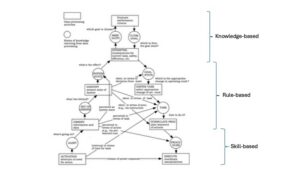
There are several aspects of the Decision Ladder that I find valuable:
- The Decision Ladder shows that there are many different paths linking perception (the left side of the ladder) with action (the right side of the ladder)
- The Decision Ladder also suggests that there are different levels or depths of analysis corresponding to knowledge-based, rule-based, and skill-based processing.
- The levels help to account for important qualitative differences in human performance - such as 'automatic' and 'controlled' processing.
However, there are also misconceptions associated with the Decision Ladder. The most significant problem is that the levels are often treated as if they are discrete categories for classifying performance. That is, that performance is either knowledge-based, rule-based, or skill-based. When the reality is that performance is always simultaneously shaped by all three processes. For example, the performance of a musician simultaneously involves knowledge-, rule-, and skill-based processes. The knowledge and rule processes don't stop when the fingers of the guitarist are performing at a skill-based level. Information is always simultaneously flowing through all levels of the ladder. However, the levels are operating at different time constants.
To combat some of the potential misconceptions associated with the box diagram representation of the decision ladder, I suggest that the levels should be represented as a nesting of constraints such that knowledge-based processing sets the constraints on rule-based processing, and rule-based processing sets the constraints on skill-based processing. For example, a musician's knowledge suggest what rule or heuristics are relevant to playing a particular style or musical piece. In turn, the rules or heuristics guide attention in a way that allows actions to be 'automatically' triggered by events. And of course the resulting quality of performance provides feedback that is simultaneously being processed at all three levels but at different time scales (or different chunks).

It is also important to realize that the mental processes are being constrained by a domain (e.g., musical performance) that includes the physical properties of the instrument, the physics of sound, and the cultural expectations of an audience.
Again - there is a lot to unpack here. But hopefully there is enough here to whet your appetite for further discussion and exploration.
I really like the idea of nested constraints instead of discrete boxes — it makes so much more sense that a guitarist's knowledge, rules, and reflexes are all firing at the same time rather than switching between them like modes.