
To say that Rasmussen's Decision Ladder or SRK Model has had a strong influence on how I think about human performance would be a gross understatement. This model resulted from Rasmussen's observations of how experts did trouble-shooting to diagnose problems in electronic equipment. He observed that often these experts took short cuts that by-passed some of the stages that are typically included in models of human information processing. Figure 1 illustrates how Rasmussen represented these short-cuts in the Decision Ladder. He suggested that these short cuts resulted in three different styles of processing: knowledge-based, rule-based, and skill-based.

Knowledge-based processing was a slow, deliberate style of analysis that involved all of the typical processing stages. This is how people typically visualize rational, analytical reasoning. Rule-based processing utilizes heuristics or tricks of the trade to by-passed the need for deep analysis. Essentially, an observation could trigger a simple rule - if you see a certain pattern or 'sign' then activate a previously learned procedure or action without the need for further analysis. These heuristic short cuts increase efficiency, allowing quicker less effortful responses to familiar situations. Though as Reason later observed, by short cutting the analysis, processing was vulnerable to specific types of errors. Finally, skill-based processing was an even more direct short-cut in which perceptions automatically elicited a response completely bypassing the need for information processing. With skill-based processes actions are directly guided by perceptual signals as might occur in a tightly coupled feedback loop. Skill-based processing is even more efficient than rule-based processing, and it also has unique vulnerabilities for error.
Note that many people before Rasmussen had noted similar qualitative differences in performance (e.g., Shiffrin & Shneider's distinction between automatic and controlled processing). However, in my opinion, the SRK model suggested a particularly elegant architecture to account for these qualitative differences.
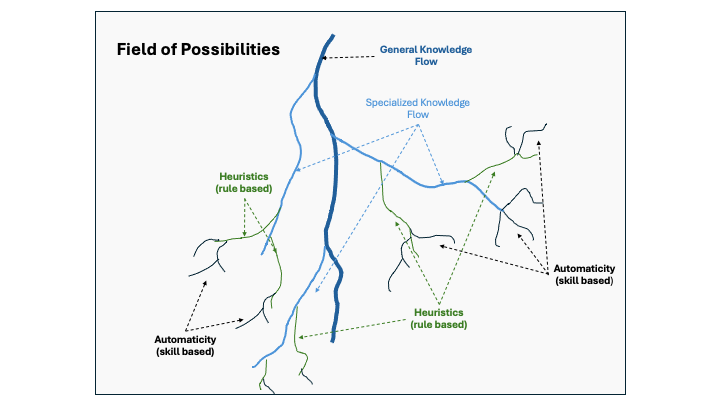
Recently, I have been reading about Bejan's Constructal Law that suggests that all natural living systems from rivers to societies are constantly evolving or self-organizing into structures that maximize flow. For example, the Constructal Law predicts the branching structures of rivers, trees, and lungs. As I considered the implications for thinking about cognitive systems - it seemed obvious to me that Rasmussen's Decision Ladder was describing a flow architecture that seemed to be consistent with the Constructal Law. As a result, I thought it might be interesting to create a representation that made this more apparent. Figure 2 is what I created.
I imagined the SRK model as a system flowing through a field of possibilities. In this representation the major river is the flow of general knowledge that is global and abstract but can't completely realize many of the performance possibilities that require more detailed direct coupling with the field (knowledge-based flow). Branching off the major river are branches that reflect specialized areas of knowledge (e.g., music theory). These branches have secondary branches that provide heuristics that reflect local constraints within the field of possibilities (e.g., blues patterns) (rule-based flow). These branches have smaller branches that are couple directly to local regions in the field of possibility to trigger skilled actions (e.g., chords and picking patterns).
What do you think? Does the alternative representation make sense? I don't intend it to replace Rasmussen's representation, which is brilliant. But I am hoping that having an alternative representation might inspire further discussion and perhaps lead to a deeper understanding of how information and skill flows through cognitive systems.
Yeah, the part about skill-based processing completely bypassing analysis is wild—explains so much about why experts can just *know* something is wrong without thinking through it.