Last week, in the middle of the pandemic, the highly publicized police killings of black men, and the resulting protests and demonstrations I learned of the death of Professor Anders Ericsson. Professor Ericsson was a preeminent psychologist who studied the development of expertise. He was interested in the development of high levels of skill that allow 'experts' to do things that are beyond the capacity of most humans. In particular, his work was instrumental in illustrating that deliberate practice was critical in developing the heuristics that allow experts to become both faster and more accurate in processing information. In essence, because of these tricks of the trade, experts are able to avoid the information limits that bound the performance of most humans. This is the positive, good aspect of heuristics. These heuristics allow experts to focus on the patterns (or chunks) that specify significant aspects of situations and to coordinate their action to respond automatically - quickly and accurately.
The term heuristic is also used to describe biases in decision making. As the extensive research of Kahneman and Tversky demonstrates, heuristics can lead people to make choices that violate the conventions of traditional logic. Heuristics are a form of bounded rationality that apply within certain domains of activity. Thus, the automatic responses that work in one set of situations can seem illogical or mindless when they are applied in situations outside that domain. This is the negative, bad side of heuristics - they can lead to performance that Jim Reason referred to as 'strong, but wrong.'
The ugly side emerges when we put people in domains where the circumstances lead them to develop heuristics or implicit biases that not only violate logic, but that violate our cultural values!
My father entered the Marines when he was 17 at the end of WW II. He only served for two years and never left the country. But in his forties, when someone tried to mug him on the street one night, he automatically responded as he had been trained - slash, kick, gouge! It thwarted the attack and may have saved his life.
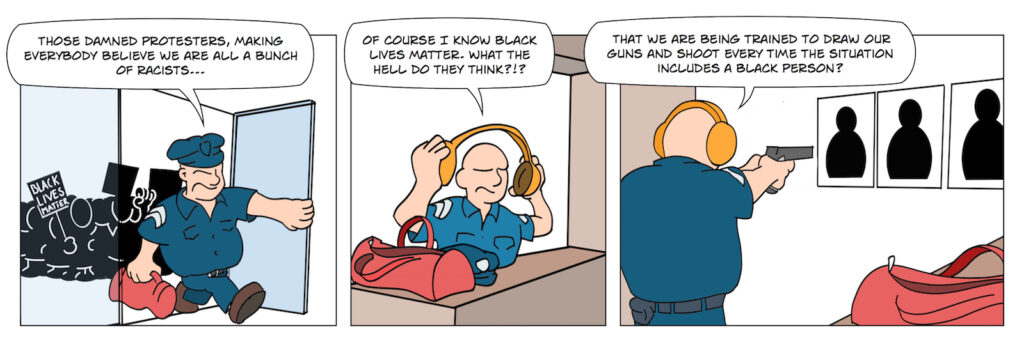
There are many parallels in the training of police and soldiers - to prepare people to respond automatically to defend themselves and to survive potentially deadly situations. It is very tempting to attribute these mindless responses to evil intent of individuals, but we might consider that these implicit biases are a product of training and socialization. These biases are the result of years of deliberate practice!
In some cases, the violent acts that we see on the cell phone videos are the result of many years of deliberate practice, that result in mindless responses to situations. The implication is that the problem of police violence is not simply a function of a few bad apples, but the product of a system that deliberately trains mindless responses to threatening situations.
In hindsight, it is easy to attribute the clearly mindless violence to evil intent. But, at least in some cases, consider that these mindless responses are the product of a system of training designed for soldiers, not for peace officers. We want to blame the officer, but this will not ultimately solve the problem of police violence. Ultimately, we must change the system and reconsider what type of skill training is most important for creating expert peace keepers, rather than expert soldiers.

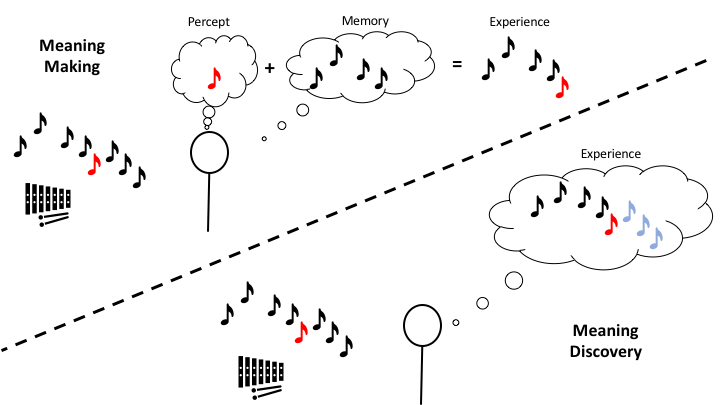
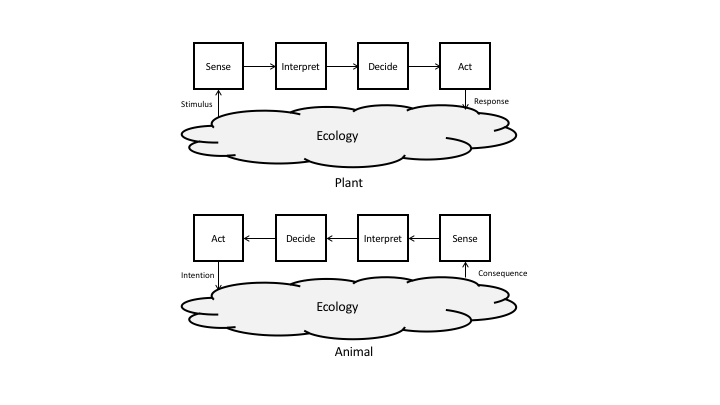 Ever since the Cybernetic Hypothesis was introduced to Psychology, there has been greater appreciation of the "intentional" nature of cognitive systems. Yet, despite this awareness, causal (or stimulus-response) forms of explanation continue to dominate the way many people think about how humans (and other animals) process information. For example, most cognition texts begin with sensation and then follow 'stimulation' through successively deeper levels of processing (perception, decision-making ...).