
Category: Uncategorized
19th International Symposium on Aviation Psychology
19th International Symposium on Aviation Psychology
Proposal Submission is Open! – New submission deadline is Nov 4, 2016
The 19th ISAP will be held in Dayton, Ohio, U.S.A., May 8-11, 2017. Proposals are sought for posters, papers, symposia, and panels. Any topic related to the field of aviation psychology is welcomed. Topics on human performance problems and opportunities within aviation systems, and design solutions that best utilize human capabilities for creating safe and efficient aviation systems are all appropriate. Any basic or applied research domain that generalizes from or to the aviation domain will be considered.
The proposal submission deadline is now November 4, 2016. We have revised the submission due to our delay in opening the Proposal Submission link.
Please see Author Info at https://isap.wright.edu/conferences/author-info for more information about the submission requirements. Contact isap2017@isap.wright.edu if you have any questions.
Thank you for your interests in ISAP and patience for the submission link to be functional.
John Flach (Symposium Chair), Michael Vidulich and Pamela Tsang (Program Co-Chairs)
19th International Symposium on Aviation Psychology
19th International Symposium on Aviation Psychology
Proposal Submission is Open! – New submission deadline is Nov 4, 2016
The 19th ISAP will be held in Dayton, Ohio, U.S.A., May 8-11, 2017. Proposals are sought for posters, papers, symposia, and panels. Any topic related to the field of aviation psychology is welcomed. Topics on human performance problems and opportunities within aviation systems, and design solutions that best utilize human capabilities for creating safe and efficient aviation systems are all appropriate. Any basic or applied research domain that generalizes from or to the aviation domain will be considered.
The proposal submission deadline is now November 4, 2016. We have revised the submission due to our delay in opening the Proposal Submission link.
Please see Author Info at https://isap.wright.edu/conferences/author-info for more information about the submission requirements. Contact isap2017@isap.wright.edu if you have any questions.
Thank you for your interests in ISAP and patience for the submission link to be functional.
John Flach (Symposium Chair), Michael Vidulich and Pamela Tsang (Program Co-Chairs)
4 – Psychology as a science of mind????
Why Wundt?
The development of psychology as a science has tended to buy into and to reinforce the dichotomy of mind and matter. In most histories of psychology, Wilhelm Wundt's lab is identified as the first experimental psychology lab - as the birthplace of a scientific psychology. However, certainly there were others who had experimental programs before Wundt (e.g., Fechner and Helmholtz).
Perhaps the reason is that whereas Fechner and Helmholtz were studying relations between mind and matter (i.e., psychophysics), Wundt, with the emphasis on introspection, framed psychology as mental chemistry. This methodology emphasized the distinction between the stimulus as an object in the ecology and the stimulus as a property of mind. And there was a clear understanding that it was only the properties of mind that were of interest to the 'science' of psychology. In fact, Titchener would characterize associations between introspections and the ecological object as 'stimulus errors.' And Ebbinghaus would focus on nonsense syllables in an attempt to isolate the mental chemistry of memory from experiences outside the experimental context.
Of course, not everyone bought into this. William James characterized the experimental work of Wundt and Titchener as 'brass instrument psychology.' In framing a functionalist psychology, James was particularly interested in mind as a capacity for adaptation in relation to the dynamics of natural selection. In this context, the pragmatic relations between mind and matter (satisfying the demands of survival) were a central concern.
Note that Wundt's research program was very broad, particularly if you consider his Volkerpsychologie. Thus, the key point is not to criticize his choice of focus or specialization. Rather, it is the later field of psychology that choses this focus as the 'birthplace' of the science that reinforces the idea that the science of psychology should be framed exclusively in terms of the mind, in isolation from matter (e.g., a physical ecology).
While Behaviorism brought the methodology of introspection under suspicion, and shifted attention to 'behavior,' the idea of 'stimulus' remained psychological (if not mentalistic) in that the nature of the stimulus (e.g., reinforcement versus punishment) was derived from the impact on behavior (e.g., increasing or reducing its likelihood), rather than as a consequence of its physical attributes. Thus, the Laws of learning could be pursued independently from any physical principles (e.g., the Laws of Motion).
The Computer Metaphor and Symbol Processing
With the development of information technologies, the mind again became a legitimate object of study. However, now the topic was not mental chemistry, but mental computation. The computer metaphor added new legitimacy to the separation of mind (i.e., software) from matter (i.e., hardware). And the new science of linguistics, with its basis in a dyadic model of semiotics (Saussure) shifted the focus to symbol processing in a way that made the link between the symbol and the ecology completely arbitrary. The focus was on the internal computations - the rules of grammar, the 'interpretation' that resulted from the mental computations. It became apparent to many that the stimuli for mental computations were arbitrary signs (e.g. C-A-T) and that the 'meanings' of these arbitrary signs were constructed through mental computations.
In this climate, people such as James Gibson, who followed the Functionalist traditions of William James in pursuing the significance of mind for adapting to an ecology, were marginalized. The field of psychology became the study of internal computational mechanisms for processing arbitrary signs. The focus of psychology was to identify the internal constraints of the computational mechanisms. In this context, the most interesting phenomena were errors, illusions, and biases, because these might give hints to the internal constraints of the computations. A mind that was successful or situations where people behaved skillfully tended to be ignored - because the internal constraints were not salient when the mind worked well.
Neuroscience
Ironically, in linking mental computations to brain structures, the dichotomy between mind and matter continues to be reinforced, at least to the extent that 'matter' reflects the physical constraints in an ecology. While neuroscience involves the admission that the hardware matters, by isolating the computation to the 'brain' there remains a strong tendency for psychology to ignore the role of other physical properties of the body and ecology in shaping human experience. For many, neuroscience effectively reduces psychology and cognition back to a mental chemistry or to brain mechanisms that can be understood independently from the pragmatic aspects of experience in a complex ecology. In this regard, I fear that increased enthusiasm for neuroscience is a backward step or an obstacle to progress toward a science of human experience.
3 – Dichotomy versus Duality
Dichotomy
A division or contrast between two things that are or are represented as being opposed or entirely different. Either/Or
Duality
Consisting of two parts, elements, or aspects. Both/And
Mind and Matter
In Western culture there is a tendency to think about Mind and Matter as dichotomous. That is, mind is considered to be a different kind of thing than matter (e.g. physical bodies). For example, the objects of mind (e.g., ideas) are considered to be massless and are not subject to physical laws (e.g. Laws of Motion). Rather, mental objects are typically associated with the laws of logic or more generally computation (e.g., information theory). This leads to a natural division between the physical sciences (e.g., physics, chemistry, and biology) and the social sciences (e.g., psychology, sociology, economics). Although both groups tend to aspire to similar methodological standards (e.g., well-designed experiments), there is an assumption that the objects of study and the natural laws constraining the behavior of the objects may be fundamentally different kinds of things. This also leads naturally to an assumption that, beyond methodology, there is little that one type of science can learn from the other. That is, there is an implication that each of the two types of sciences can be complete without considering objects of the other type. In other words, there is an assumption that the software can be understood independently from the hardware, and vice versa. The soft sciences study the software and the hard sciences study the hardware.
As the old saw goes: What is mind, never matter. What is matter, never mind.
This view that Mind and Matter are dichotomous is reflected in the parsing of the puzzle shown on the left of the figure below. The challenge for such a perspective is how to address properties of human experience that depend on relationships between mental things (e.g., desires, sensitivity, capability) and physical things (consequences, appearances, physical layout). The challenge is how to add two fundamentally different kinds of things together into a coherent narrative with respect to human experience that reflects properties such as satisfying (e.g., whether a particular type of food will satisfy the desire for healthy nourishment), specifying (e.g., whether a particular pattern in a visual flow field will specify a safe separation from the car ahead of you), or affording (e.g., whether an object requires a one-handed or two-handed grasp).
In fact, one might ask which of the two sciences (i.e., physical or social) owns the phenomenon of human experience? Which science determines whether something is satisfying, whether something is specified, or whether something is afforded? Or do these aspects of experience fall into the gap between the two distinct sciences.
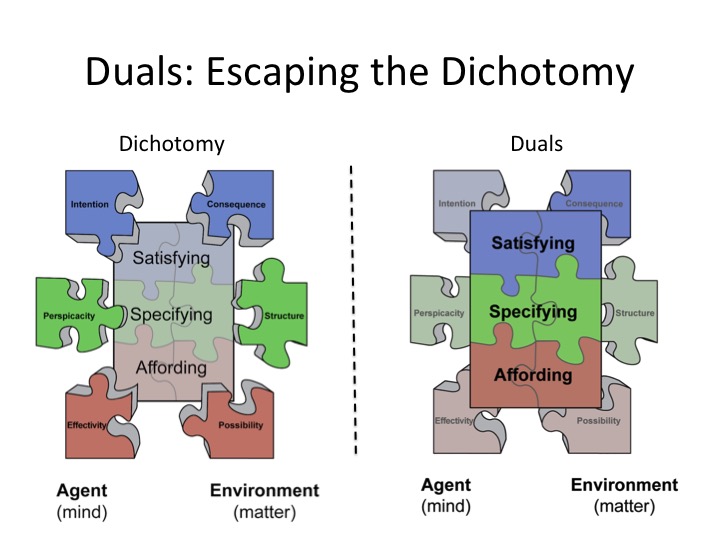
The puzzle diagram on the right suggests a different framework for a single science, where experience is considered to be a joint function of mind and matter. In this perspective, satisfying, specifying, and affording become the objects of study - where these objects are considered to be duals. That is, they reflect relations spanning mind and matter. Thus, each object is ill-defined without specification of both aspects. Thus, the affordance of graspable reflects a relation between the size of an object (e.g., a basketball) and the size of a hand. The specificity depends on a relation between structure in an optical array (e.g., patterns of angular expansion) and an appropriately tuned sensor (e.g., a well-tuned, attentive eye). The satisfying attribute depends on the relation between intentions, needs, or desires (desire for nutrition) and the actual physical consequences (e.g. the digestibility of an object).
The duals of affording, specifying, and satisfying are suggested as the fundamental objects of study for a unified science of experience. These objects are duals in the sense that they refer to relations over mind and matter.
In a recent article on new approaches to designing human experiences, Sanders and Stappers (2008) write "We are heading into a world where experience trumps reality." I think that perhaps William James and Robert Pirsig might suggest something even more drastic. They would perhaps argue that - experience is reality!
This is a major theme developed in our book What Matters. The claim is that the parsing in the left puzzle diagram that treats mind and matter as independent objects of study, breaks human experience into pieces that will never add up to a coherent narrative. On the other hand, we argue that the parsing represented in the right puzzle diagram is a parsing that may be a first step toward a unified science of human experience that spans mind and matter.